May 14, 2026

August 13, 2015
Wild Sage Bistro, Spokane

"Why aren't they bringing the dessert menu?" asked fellow foodie, some what puzzled as we sat back in anticipation of more delights after a really superlative meal.
Well, now, we have to go back a few days to some scheming on my part and some really great service on the part of Wild Sage. We had always wanted to have a meal here - a place that has "a menu that allows (us) to be creative on a daily basis, and work within the limits of what is in season and available" And isn't that just the best way to eat? eat locally and have ingredients at their best?
And so it was that for fellow foodie's birthday, she made a reservation for dinner. Unbeknownst to her, I had emailed Wild Sage and they were in the know of the birthday celebrations and together planned a birthday dessert!
On the day we arrived, hungry after a day of mountain biking in Riverside State Park, WA, the Bistro was bustling with happy diners. We were shown to our seats by Heather Ann and soon we had cold water for thirsty throats and quickly chose a glass of wine each.

Their famous popovers appeared, light as a cloud, accompanied by lavender butter... mmm! A taste of summer.
 |
| light as a cloud Popovers |
Mellow with a few sips of wine (we had empty tummies!) we pondered over menu choices... As a nod to healthy dining, we chose Pea Vine Salad - a refreshing combination of English peas, pea vine tendrils, arugula... topped with a parmesan vinaigrette. Sharing it - (and Wild Sage plated it into two beautiful plates for us) so that we had tummy room for full meal deal. The pea puree was cool and fresh, contrasting well with the peppery arugula and salty parmigiano. Good start it was.
Moving on to the meat of the matter, birthday girl splurged on Filet Mignon - tender, flavourful, melt in your mouth Double "R" signature northwest beef - on a bed of startlingly purple mash and playful crispy leeks on the side. The sauce was so good, we were glad for the mash so that could eat every drop of it.
 |
| Filet Mignon |
I usually choose things that I don't cook and that Dry Aged Pork Loin Chop was just called my name. It's hard to get a well cooked (not well done) pork chop that is still juicy and doesn't have the texture of cardboard. Now, this Pork Chop was something else! First of all, it was HUGE. I have never eaten such a large chop, and it was well seasoned, juicy, resting on mashed purple potatoes... and topped with crispy pork belly! Oh my!
 |
| Dry Aged Pork Loin Chop |
What amazing food! And contrary to our usual practice, we didn't swop plates - it was just too good, although we did sample bites of each other's entree. Thoroughly enjoyed it.
Sitting back after the plates were cleared away, we are back to the question we started this blog with... "Why aren't they bringing the dessert menu?" The reason was soon clear, when Heather Ann astutelydeduced which diner was the birthday girl and brought a slice of their "Soon to be Famous Coconut Cream Layer Cake" complete with candle. No singing thankfully! Big Smile from Birthday girl. That cake should really be "Famous" - light, not too sweet, a great ending to a fabulous dinner.
 |
| Soon to be Famous Coconut Cream Layer Cake |
Thank you Tom (my partner is crime) and Heather Ann and Wild Sage for a truly memorable meal. We'll definitely be back.
June 15, 2015
Where BC travellers ate at, & would recommend - Kelowna
Raudz
Ate here in 2010. Loved the food, loved the ambience, loved the service. Recommended this place to many friends and they loved it too. Decided to come here again 5 years later. Very happy Raudz has kept up it's high standard of great food & service.
Tip: If you don't want to wait for a table, have dinner by the bar.
Ate here in 2010. Loved the food, loved the ambience, loved the service. Recommended this place to many friends and they loved it too. Decided to come here again 5 years later. Very happy Raudz has kept up it's high standard of great food & service.
 |
| Seared Albacore Tuna |
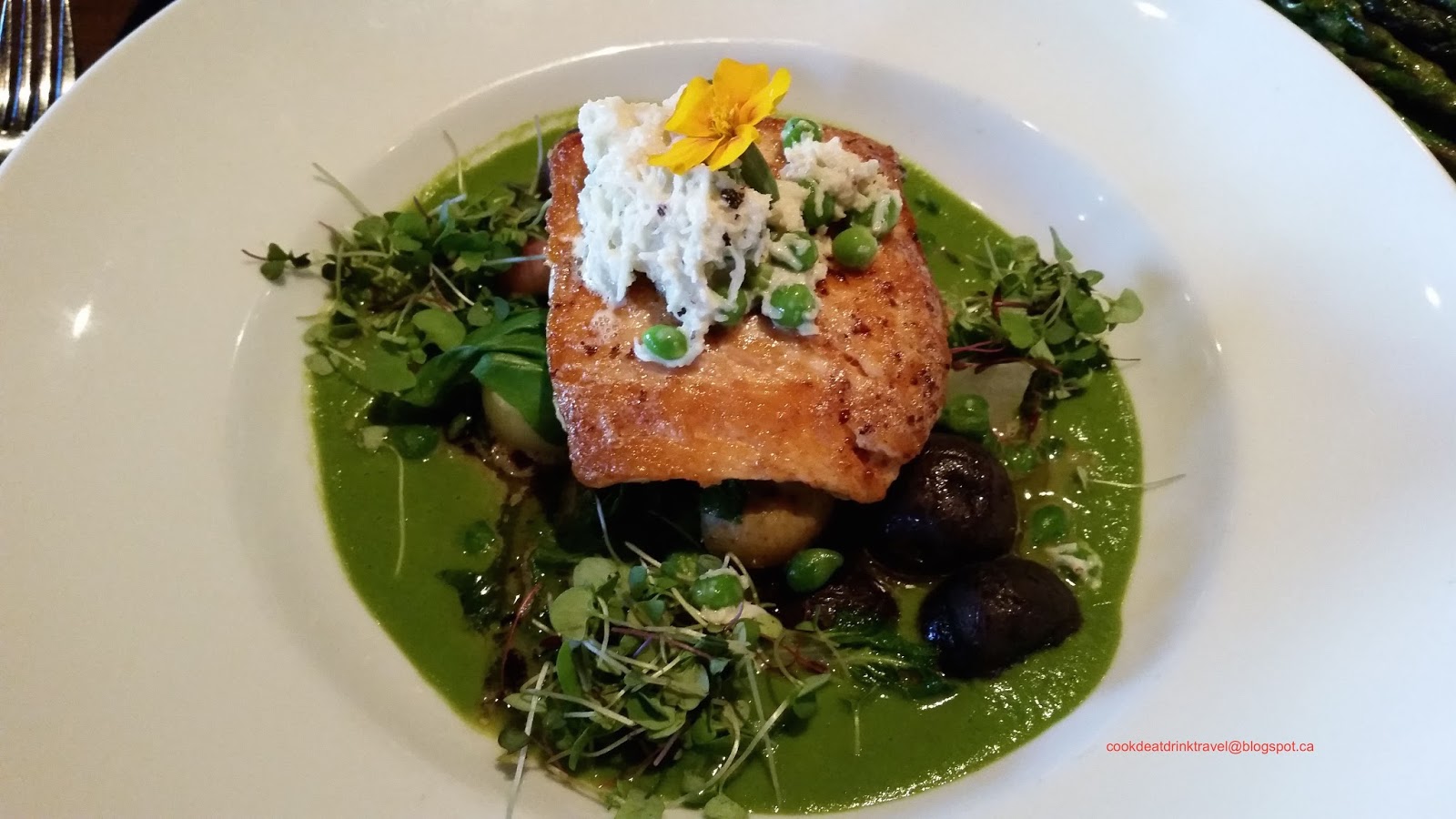 |
| Spring Salmon |
 |
| Halibut |
 |
| Crème brûlée |
June 8, 2015
Where BC travellers ate/drank at, & would recommend - Ballard, Seattle (Part2)
Here's part 2.
Another place we have visited twice on two separate trips. Awesome place - great food, extensive drink list and friendly service. Always crowded - be prepared to sit close to another table. Highly recommend this place!
 |
| Oysters!!! |
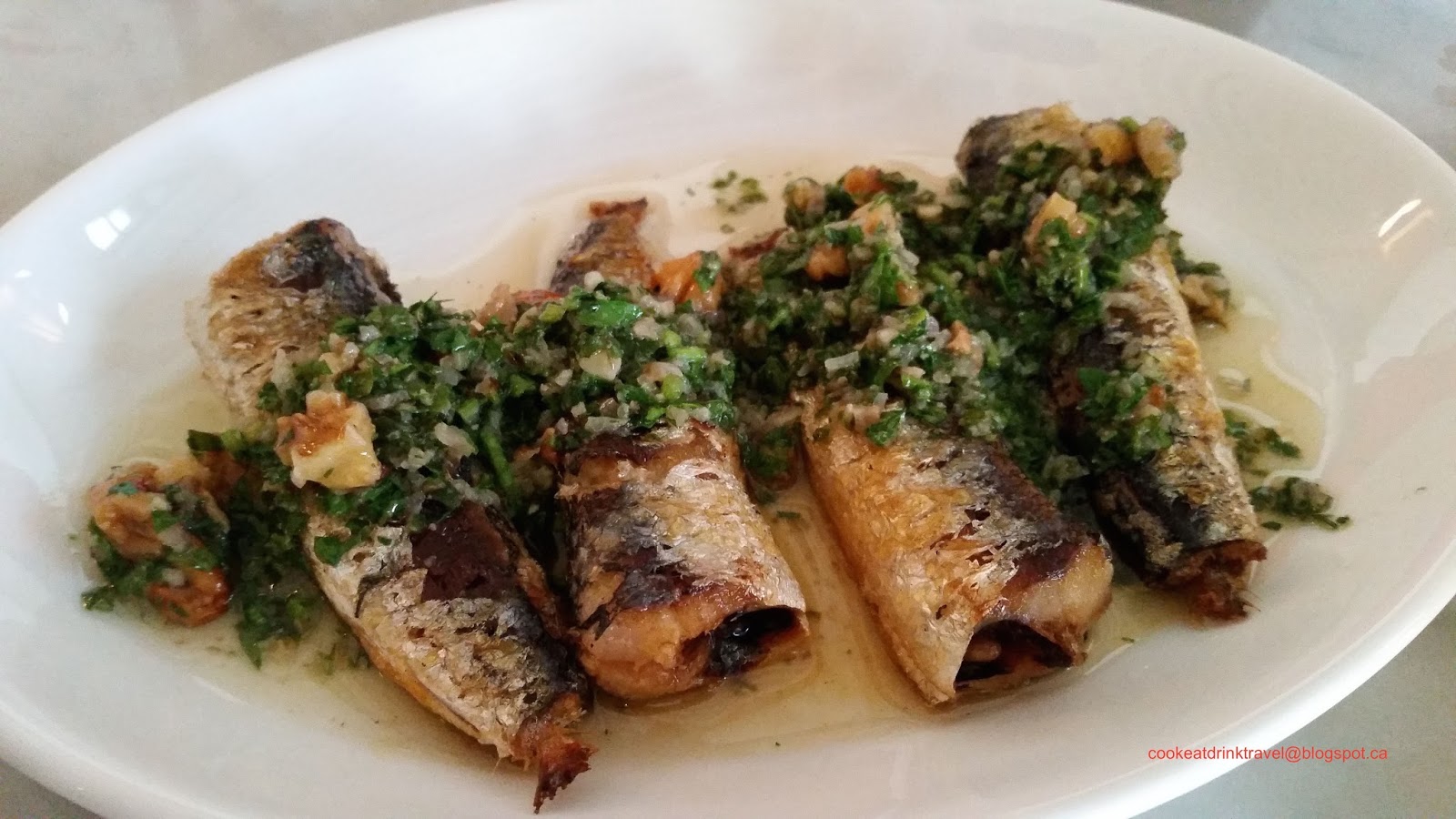 |
| Grilled sardines |
 |
| Steak tartare |
This place was bustling when we came here for dinner.
 |
| Buratta - charred ramps, carrots a la grecque, grilled bread, admiralty sea salt |
 |
| Grilled asparagus with carrot top gremolata, Italian pine nuts, salt cured egg yolk |
 |
| Orechetti with rapini, chili, botarga, smokey bread crumbs |
How about a place (or two) for after dinner drinks?
250 scotches enough for you?
 |
| Behold! The scotches... |

Ocho
Came here for drinks after dinner one night because we were to full to have tapas. Friendly and knowledgeable bartender.


June 7, 2015
Where BC travellers ate at, & would recommend - Ballard, Seattle (Part1)
Decided to start this series of "Where BC travellers ate & would recommend" after friends kept asking us to recommend places to eat in places we have visited. The first of the many (hopefully) - Ballard in Seattle.
Geo's Cuban & Creole
Came here for lunch. Decided to order a traditional pan con lechon and pan con lechon just to compare and contrast. Love the crispy chicharonnes in the traditional. The meat is really moist and tender. Yummy all the way.
Pestle Rock Isan Thai Cuisine
Authentic Thai food - reminded us of our travels in Thailand. We asked them for "Thai" spiciness and we were not disappointed.

La Isla Cuisine
Eaten here twice on two separate trips. Comfort food.
El Camion
Busy place. The queue to order food was long and by the time the food came, it was easily a 20 minute wait. But the food is worth the wait. Staff are friendly.
Geo's Cuban & Creole
Came here for lunch. Decided to order a traditional pan con lechon and pan con lechon just to compare and contrast. Love the crispy chicharonnes in the traditional. The meat is really moist and tender. Yummy all the way.
 |
| Traditional pan con lechon |
 | ||||||
| Pan con lechon |
Pestle Rock Isan Thai Cuisine
Authentic Thai food - reminded us of our travels in Thailand. We asked them for "Thai" spiciness and we were not disappointed.
 |
| Som Tum - green papaya salad |
 |
| Kanom Jeen Nam Prik |
 |
| Tua Pad Kapee - we asked the chef to replace the beans with water spinach |

La Isla Cuisine
Eaten here twice on two separate trips. Comfort food.
 |
| Sopa De Lentejas |
 |
| Empanadilla - Queso |
El Camion
Busy place. The queue to order food was long and by the time the food came, it was easily a 20 minute wait. But the food is worth the wait. Staff are friendly.
 |
| Gorditas - lengua, tripas & cabeza |
 |
| Tacos - lengua, tripas & cabeza |
 |
| Rice & beans |
December 30, 2014
Bouncing Balls... (or how to make fish balls "Q-Q")
 |
| Chinese Fish Ball Tang Hoon Soup |
Problem is, out here in the Kootenays, fish balls are as rare as polar bears in the Straits of Malacca. So it's back to DIY. I had tried this once before and ended up with very soft fish balls, more like fish quenelles, rather than the typical springy bouncy texture that chinese fish balls have. This texture is also described as "QQ" - for the life of me, I do not know the chinese word for it, so I'll have to make do with the onomatopoeia.
The key or secret to springy fish balls has to do with food science. Remember how we have to knead bread dough to develop the gluten and make those strands all tangled and tight? And that these gluten strands trap the CO2 given off by the yeast giving a nice crumb and also providing that chewy texture? Meat / fish have protein strands and these strands need to be developed in a similar manner. Typically, the fishmonger in the Asian wet market will take hand-fulls of minced fish meat and slap or thrown them vigorously against the side of a large basin. We do that in the home kitchen too, but being mindful of clean-up afterward, one might chose to do this with the basin in a deep sink or else line your worktop with newspaper. Also important is not to use a food processor that finely minces the fish meat - this makes that tangle of protein strands harder to achieve. Once you have roughly chopped the fish meat, the remainder of the "mincing" process should be carried out with the flat, non sharp edge of a chef's knife or chinese cleaver.
 |
| Pieces of firm white fish |
The fish that I used was any firm white fish that I could find in the supermarket. Usually in SE Asia, the best fish balls are made with spanish mackerel or yellowtail snapper.
A word about the other ingredients:
1. Tang Hoon: vermicelli made from mung bean flour - available in most Asian grocers
2. Tian Jin Dong Choy (天津冬菜) - - available in some Asian grocers - salty, garlicky
 |
| Tian Jin preserved cabbage |
Chinese Fish Balls
Ingredients:
1 kg white fish fillet, deboned (I used haddock)
1-2 tsp table salt (depending on how salty one likes their fish balls)
1/4 - 1/2 tsp white pepper
1 Tabsp corn starch
Method:
1. finely chop then mince the fish meat as described above
2. add the salt and pepper
3. gather up the fish mixture and throw / slap it vigorously against the side of a deep basin (I counted 100 throws)
4. add the cornstarch and mix thoroughly - a few more slaps would not hurt!
5. test cook a fish ball in boiling water to check for taste and texture - if it is not "QQ" enough, throw it about a bit more
Forming & Cooking the fish balls:
1. Bring a large pot of water to simmering (add 1tsp salt to each litre of water)
2. gather up a handful of fish mixture in your left hand (if you are right handed)
3. gently squeeze a small quantity through an "O" created by the thumb and fore-finger of the left hand and using a tablespoon dipped in cold water, scoop up a ball and drop that gently into the simmering water. (it will sink)
4. Once the fish ball is cooked, it will float to the top, scoop it out and place in a bowl.
5. Depending on the size of your pot, you can cook about 6-10 fish balls at a time.
This recipe makes approximately 24 fishballs
 |
| Cut the fish into small pieces |
 |
| finely chop the fish meat |
 |
| gather the fish meat in both hands and "slap" it back into the basin with a good wrist action |
 |
| the final result should look smooth and shiny |
 |
| Forming the fish balls (1) - take a small handful in non dominant hand |
 |
| Forming the fish balls (2) - use a teaspoon and scoop a round ball about 2cm diameter |
 |
| Drop uncooked fish ball into simmering salted water |
 |
| Fish balls will float when cooked |
Fish Ball "Tang Hoon" soup
- 1L fish stock
- 24 fish balls
- handful coriander / cilantro - chopped
- small bunch scallions / spring onions - chopped
- deep dried finely chopped garlic
- deep fried finely sliced shallots
- 2 small bundles bean vermicelli (not rice vermicelli) - soaked in cold water and cut into 3-4inch lengths with a pair of scissors
- 1 Tbsp Tian Jin Dong Choy (天津冬菜) preserved vegetable rinsed and roughly chopped
- bring the fish stock to boil
- add fish balls and preserved vegetable
- add the vermicelli
- simmer for 10min
- season to taste
- add as much cilantro and spring onions as you like
- sprinkle with deep friend onions and garlic just prior to serving
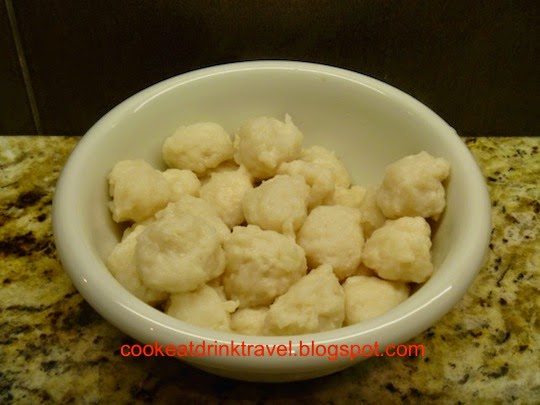 |
| cooked fish balls |
December 23, 2014
Tis the Season... for edible gifts (1) - Wine Jelly

Christmas tools around really quick! the older one gets, the faster time flies by. Christmas here is is kinda like Chinese New Year back in Singapore. Lots of visiting, feasting, and exchange of gifts (instead of "ang pows")
This is our 3rd Christmas here and we have been recipients of many little tokens of friendship, both edible and non edible and have experienced warmth and love. So in turn, since we're not too hot in the arts and crafts department - we decided to make edible gifts. This year it's Wine Jelly and Cinnamon Bread.
 |
| Jars filled, waiting for labels |
We chose my favourite varietal - Cabernet Sauvignon and set about filling our apartment with wine fumes as the jelly cooked. We did taste a glass - quality control of course, and pronounced it good everyday drinking wine, perfect for jelly.
 |
| all nicely labelled, ready to be delivered |
Hints:
First make sure you have enough jars - I often get caught out with insufficient jars because I had not factored in the volume created by dissolved sugar!
Also ensure that your pot is large enough to contain the "roiling boil" that occurs - the hot jelly liquid rises up quite a ways in the pot. A large pot will save faint hearts from angina. You may stir the boiling wine mixture with a wooden spoon to try and prevent the scalding hot jelly from overflowing.
The recipe below makes 12 x 250ml / 24 x 125ml jars of jelly
Ingredients:
1.5L Red Wine (your favourite)
1 Cup (250ml) freshly squeezed lemon juice - about 4-5 large lemons
2 pkg (2x 57g) Bernadin Fruit Pectin
9 Cups extra fine granulated sugar
Sterilise the Jars:
There are various ways of sterilizing jars - I'll detail the two that I use most often
Oven Method:
1. wash jars in hot soapy water, rinse well and place on baking tray
2. place in cold oven and bring temperature up to 110C / 225F for 30min
3. allow to cool slightly before filling (in other words, leave in oven till ready to fill)
Dishwasher method:
This is great is you have a larger quantity of jars and haven't yet washed them.
1. place jars and lids in dishwasher
2. wash at the hottest setting
3. allow to dry (use heat dry setting) before use.
Sterilise the Lids:
1. place lids in large pan
2. pour boiling water over the lids and let sit for 10min.
Method:
1. Pour wine and lemon juice into large pot - whisk in pectin till dissolved
2. Measure sugar, set aside
3. Bring wine mixture to boil
4. Add sugar to wine mixture, bring up to a railing boil and boil hard for 1min (exactly)
5. Remove from heat
6. Skim foam if necessary
7. Bottle up to 5mm of rim of jar
8. Place lids (shake off any water) onto jars (hot!)
9. Carefully place rings over lids and screw down firmly.
10 Set aside on tray to cool.
I love sitting back after all the effort and listening for the lids to go "thuk" as the lids get sucked in and seal off the jars during the cooling process. Once the jars are well sealed and cool, wipe any sticky jelly drips off the sides and label.
Wine jellies are great with cheese and crackers and they also make a fantastic glaze for roasts.
 |
| match made in heaven? wine jelly, cheese and crackers |
December 15, 2014
Saving my culinary heritage... one recipe at a time This time it's Ondeh - ondeh
 |
| Delicious Plate of Jade Green Ondeh Ondeh |
OK, enough ranting - so - we had some friends over for dinner and we decided to serve something "local" - Laska Lemak for mains. Then given a choice between making "appies" or dessert - the latter won. Now, I could easily whip up a decadent creamy sherry trifle or a sea -salt caramel apple crisp, but that wouldn't have been an appropriate sweet ending to the meal. After searching through our library of recipe books, Ondeh-ondeh came up tops. These scrumptious little balls have a lovely jade green colour and when coated with soft fragrant finely grated coconut, a mound of these on a plate look almost festive, Christmassy - like a little pine tree covered with snow.
Ondeh-ondeh (or onde-onde) are little balls of sweet potato / glutinous rice flour, filled with melted palm sugar and coated with grated coconut. They should have just enough chewiness in the dough to avoid being stodgy, yet enough"give" that when popped into the mouth and given little squish with the tongue, they pop, filling one's mouth with aromatic sweet palm sugar syrup. Mmmmmm!
There seem to be 2 distinct groups of recipes for Ondeh - Ondeh. Those that use sweet potato and hardly any glutinous rice flour and those that use only glutinous rice flour (plus a smidge of tapioca flour). The former I find too soft and not toothsome enough. The latter can be quite rubbery, especially if there is too little filling in the dumplings. After a bit of experimentation I've came up with a compromise, which I'm posting today.
The key to this recipe is to make "test balls" as the humidity, water content of the sweet potato will affect the final consistency. Don't make up a whole batch of dumplings only to find that they don't meet texture / consistency expectations once cooked.
Some of the instructions and ingredients are appropriate for cooks in places without Asian grocery stores. Fresh Screwpine leaves and grated fresh coconut is ideal when available, but Pandan flavouring paste by Koepoe Koepoe (easily bought online from Amazon.com) and desiccated coconut works well. The panda paste is intensely fragrant and dark green, so no further colouring is needed. Dark demerara sugar or muscovado sugar if you cant get hold of palm sugar or gula melaka (coconut sugar)
 |
| Pandan Paste |
Ondeh-Ondeh
(makes 36 dumplings)
Ingredients:
1 medium sweet potato - white / pale fleshed is best - about 400g
1.5 Cups Glutinous rice flour
approximately 1/3 Cup water
1 tsp pandan (screwpine) essence
1/3 - 1/2 Cup finely shaved palm sugar / gula melaka (coconut palm sugar)
200g finely shredded desiccated unsweetened coconut
1/2 tsp fine / table salt
Rehydrating Desiccated Coconut:
Mix the desiccated coconut with salt, spread on a 9inch pie dish and steam over boiling water for 10minutes. Let cool completely before use.
Make the dough:
1. peel and cut the sweet potato into 1cm cubes
2. steam / microwave for 5min till cooked and soft.
3. mash (and sieve if you are really finicky) and let cool completely
4. mix in the glutinous rice flour, panda essence and enough water to make a dough that has the consistency of plasticine or "playdoh"
5. Cover with cling film to prevent the dough from drying up
 |
| Making a well in the dough |
1. Bring a pot of water (about 1.5L) to boil and keep simmering on low heat
2. Make batches of dumplings - about 10 at a time
3. Pinch off enough dough to make small round balls of dough about 2.5-3cm diameter
4. Use a finger to make an impression in the ball and work the dough to create a little well for the sugar. With practice, the wall of dough becomes really thin ideally about 2-3mm thick and leave room for lots of sugar !
5. Carefully place 1/2 tsp sugar into the well and close the dough over it, gently roll the ball in your hands and set aside. Repeat process till you have 10 little filled dough balls
6. Gently lower the balls one at a time into the simmering water (they will sink)
7. Once the dough balls are cooked, they will float
8. Remove the balls from the water with a skimmer / tea strainer / slotted spoon
9. Set aside on a non stick mat / baking sheet to drain briefly
10. Transfer to the pie dish with rehydrated coconut and roll to fully coat.
11. Set aside and repeat steps 3-10 till all the dough is used up
 |
| When dough is cooked, the balls will float |
 |
| Roll cooked balls in coconut |
Dumplings are best eaten at room temperature - they will keep, covered in the 'fridge for a day or two, but let them come to room temp before eating. When eaten warm, they tend to be too soft.
 |
| Coconut sugar oozing out... |
Enjoy... keep lots of Kleenex handy to catch drips! Mmmmmmm....

Subscribe to:
Posts (Atom)
